Oko Farms: Fish, Food and Friendship in Brooklyn

The Oko Farms Aquaponics Education Center located at 104 Moore Street, Brooklyn. It is the only outdoor aquaponics farm in New York City. The farm was established in 2013 and serves as a production, research and education farm. It’s an incredibly interesting and fun place to be, and they’re expanding to another site in Weeksville soon.

Their stated mission is twofold:

1.Practice and promote aquaponics as a sustainable farming method that mitigates the impact of climate change, and increases food security for New York City.

2. Spread the knowledge and skills required to practice aquaponics farming by educating children and adults of all racial and socio-economic backgrounds.

A little primer from The Aquaponic Source website in case you’re not sure what aquaponics is. I wasn’t until I visited Oko Farms!

Many definitions of aquaponics recognize the ‘ponics’ part of this word for hydroponics which is growing plants in water with a soil-less media. Literally speaking, Aquaponics is putting fish to work. It just so happens that the work those fish do (eating and producing waste), is the perfect fertilizer for growing plants. Aquaponics represents the relationship between water, aquatic life, bacteria, nutrient dynamics, and plants which grow together in waterways all over the world. Taking cues from nature, aquaponics harnesses the power of bio-integrating these individual components:  Exchanging the waste by-product from the fish as a food for the bacteria, to be converted into a perfect fertilizer for the plants, to return the water in a clean and safe form to the fish.

The Aquaponic Source

I visited Oko farms at the end of 2016 interview the founder and director, Yemi Amu, for a podcast I made called ‘Maeve in America: Immigration IRL.’ This was a podcast about immigrants, in our own voices. Yemi featured in “The Yemi Episode: Coming To America” where we discussed her immigration from Lagos, Nigeria to New York City as a teenager, her eating disorder, and her path to becoming one of the city’s leading aquaponics experts and a committed educator. Thinking on it now, I wonder if disordered eating intersects with climate injustice in that colonialism and capitalism contribute massively to both. In striving for some impossible idea of constant growth and perfection, we harm what already serves us well and keeps us alive: our bodies in the former, and the latter, the planet.

Of the Climate Action Lab videos we watched, one of the participants really stood out to me. Saara Nafici from Value Added Farms in Red Hook, Brooklyn spoke about that two site urban farm project as a “space of joy” for the young people that work there, what the Lab summarizes as  “providing a kind of collective psychic and spiritual sustenance in tandem with the healthy products grown and distributed by the farms themselves.”

Oko Farms echoes this message, that joy is an important part of their work, saying in a recent post about growing jute:
“It is a great opportunity to be able to grow food that sparks joy in people, connects them to home, and reflect our diverse food cultures.”


Oko Farms has had a vigorous response to the recent shifts in the Black Lives Matter movement, using their social media to support and expand on the BLM message. This includes educational posts about Juneteenth as well as fundraising and distributing funds to pertinent black organizations and individuals, like ‘Gardens Not Guns’ with the goal of getting money directly into the hands of BIPOC land stewards, healers, community gardens and mutual aid organizations.

This summer the farm is largely closed to visitors due to COVID-19, meaning no workshops or tours like they usually host, but they still harvest and sell food at local Brooklyn food markets.

The best place to follow them right now is Instagram.

https://www.instagram.com/okofarms/?hl=en

Seneca Village Teapot

When Environmentalism Goes Too Far

A reading response, by Lala St. Fleur

The social consequences of putting deep ecology into practice on a worldwide basis (what its practitioners are aiming for) are very grave indeed.

Ramachandra Guha, Environmental Ethics, 1989.

Environmentalist Subhankar Banerjee’s 2016 paper, “Long Environmentalism: After the Listening Session,” demonstrates how indigenous resistance movements inadvertently highlight the pitfalls of certain conservationist issues that prioritize nature over human beings. Banerjee coined the term “long environmentalism” in reference to ongoing environmental engagements that create their own histories and cultures of environmentalism (2016: 62). According to Banerjee, long environmentalism can foster coalitional relationships between indigenous people and government institutions, by doing four things: (2016: 62-63)

  • illuminating past injustices
  • highlighting the significance of resistance movements to avert potential social-environmental violence (fast and/or slow)
  • showing how communities respond to slow violence, and
  • pointing towards social-ecological renewal after devastation 

This is especially important in the face of biocentrism, or deep ecology, where nature is given “ethical status at least equal to that of humans,” to the point that the preservation of nonhuman biotic life and biospheres becomes is served to the detriment of preserving indigenous ways of life, (2016: 63).

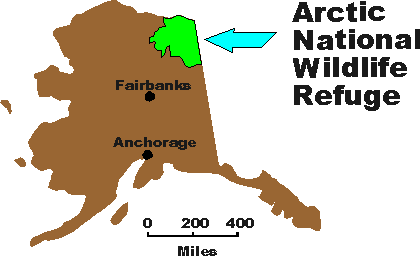
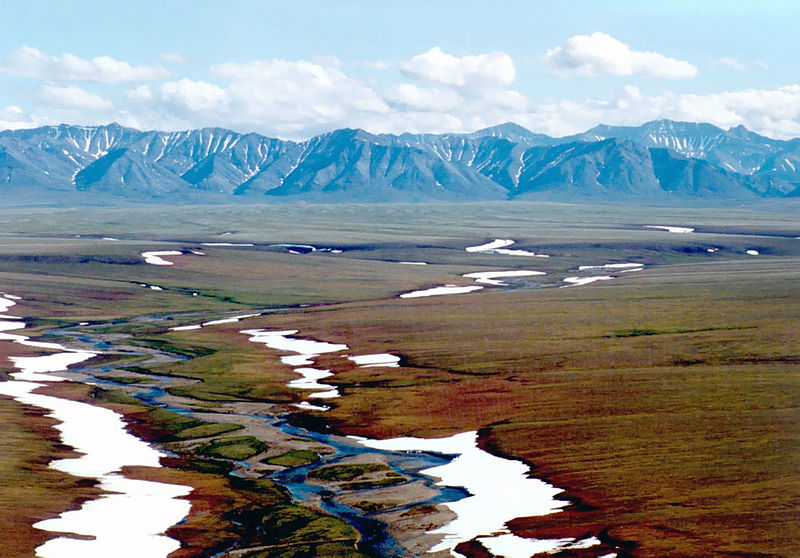
Banerjee’s paper uses the plight of the Gwich’in and Iñupiat Alaskan natives as case studies for examining ways that environmental conservationist concerns need to be reconciled with the protection of human rights. For decades, Alaska’s indigenous tribes have found themselves in land disputes against the American government over the Arctic National Wildlife Refuge, cordoned off by the Public Land Order of 1960. This Alaskan coastal territory held precious oil and gas reserves for industrialists; pristine wilderness land conservationists lobbied to protect; and “nutritional, cultural, and spiritual sustenance” for the Gwich’in and Iñupiat (2016: 65).

With the indigenous cultural traditions enacted in their own homeland criminalized as everything from poaching, arson, and outright theft by the conservationists, the Alaskan indigenous groups were summarily stripped of their rights to access their own ancestral land, all for the sake of “preserving unique wildlife, wilderness, and recreational values,” of white tourists and conservationists, not the original inhabitants, (2016:67).

Hard-fought coalitions like the 1980 Alaska National Interest Land Conservation Act (ANILCA) and the 1988 Gwich’in Steering Committee have worked to bring together tribes and environmentalists to both protect precious wilderness from drilling and deforestation, as well as protect indigenous rights to subsistence hunting–though the former is often prioritized over the latter.

Banerjee’s paper reminded me of other instances where eminent domain was enforced in the name of environmentalism, to the detriment of the original inhabitants. As a resident of New York City, my mind was immediately taken back to the creation of Central Park, the emerald jewel in the heart of Manhattan’s concrete jungle.

Panoramic view of Central Park from Rockefeller Center, 2008. Wikimedia Commons.

Central Park was the magnum opus of New York City’s 19th century Environmental Movement, which was a direct response to the the destruction of the natural landscape and shrinking of the “green” environment of the city, as the rapid industrialization, urbanization, and population boom of the mid-1800’s took over what was once lush wilderness. Municipal sanitation was still in its infancy, and in no position to tackle the overwhelming pollution littering the streets.

The city is dirtier and noisier, and more uncomfortable, and drearier to live in than it ever was before. I have bad my fill of town life, and begin to wish to pass a little time in the county.

William Cullen Bryant, romantic poet (Letters, September 1836: 87).

Inspired by the writings of naturalists and reformers including Henry Thoreau, Ralph Emerson, and Horace Greely, landscape architects Frederick Olmsted and Calvert Vaux were hired by NYC in 1858 to beautify the city, and create a public park in the spirit of environmental preservation. Thus, Central Park was born, the most visited urban park in the USA, and most filmed location in the world.

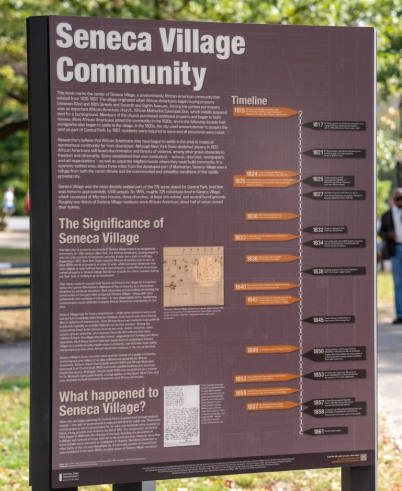
However, what is not so famously known is that in order to create Central Park, an entire community of over 1600 free African-Americans who lived on that land from 1825 – 1857 were forced off of their property through eminent domain; their communities scattered throughout parts of NYC and New Jersey; their homes leveled so that Central Park could be built.

A temporary outdoor exhibit, called Discover Seneca Village.

Remnants of Seneca Village were uncovered in a 2011 excavation by archaeologists from Columbia University and CUNY schools. Amidst the foundations of Seneca Village’s buildings were several thousand 19th-century artifacts, including household items and other abandoned or discarded personal effects.

With Seneca Village and the Arctic National Wildlife Refuge in mind, one really must consider both the benefits and pitfalls of unchecked industrialization and development, as well as overzealous and inconsiderate environmentalist movements. There have been amazing strides taken to preserve natural landscapes and endangered biospheres. But there have also been heinous crimes committed against the rights and lives of human beings, who are disenfranchized by biocentric conservationists who care more about land than the people who live in it.

Through the Climate Artist’s Lens

Following are profiles of a few climate artists and how their works explore our relationship with the environment. Though the artists mentioned here create various types of work, this blog focuses on their installations in urban spaces where we are most likely to forget our relationship with nature.

River Rooms by Stacy Levy, 2018

STACY LEVY – The site specific installations of Stacy Levy visualize natural elements such as wind, rain, sunlight, and waterways. These installations are weaved into urban design and placed in public spaces. They invite the public to interact with the natural world that lives and breathes alongside them, but is often unnoticed. Levy’s series of works called Tides are installed in city parks. “River Rooms” are boat shaped structures placed along the Schuylkill River. They allow people of the city to sit by the river and observe it all year round. Similarly, “Tide Field” in the Schuylkill River in Philadelphia and “Tide Flowers” in the Hudson River in New York are floating devices that respond to the river’s tides. They change based on how high or low the water in the river is. Both installations are placed where city dwellers can see the rivers change throughout the day. It’s a reminder that the rivers are alive even in densely populated urban areas.

Reduce Speed Now! by Justin Brice Guarriglia, 2019

JUSTIN BRICE GUARRIGLIA – Messages about the existential crisis of climate change are brought to public spaces through Justin Brice Guarriglia’s LED light installations and marquees. Guarriglia reminds us that “We are the asteroids” that are threatening our world. His project, Eco-Haikus for Marquees, places haikus about climate change at the entrance of theaters in Los Angeles and New York City. Guarriglia draws inspiration from the writing of Bruno Latour and attempts to make abstract ideas about climate change more accessible to the public. Reduce Speed Now is another project of Guarriglia’s. It’s an installment of solar powered LED lights that share messages from climate activists, artists, philosophers from around the world. This project was created for a 2019 Earth Day event in London and it invited the public to share their own messages through the LED light installations during the event.

Ice Watch by Olafur Eliasson, 2015

OLAFUR ELIASSON – When looking through the images of Ice Watch and how people interact with it, we see a combination of spectacle and mourning. Olafur Eliasson created Ice Watch, an installation, by transporting floating icebergs from the fjords of Greenland to public spaces in London and Paris. It confronts the public with the fact that the glaciers are melting in a more intimate way. The installation evokes the cathartic feeling of time running out and watching something bigger than us slowly fall apart. While walking through these icebergs, some people are in awe and can’t help but take selfies with them. Others kiss, hug, or hold the icebergs in a regretful way because they understand what we’re losing. For most of us, the melting glaciers is something that is happening far away. Watching videos of glaciers melting in the news or in documentaries doesn’t begin to describe the profoundness of this loss and the danger associated with it. Eliasson tries to change that with “Ice Watch”. 

To ignore or not to ignore?…There is no question

Stengers encourages her audience to see beyond the superficial fallback excuses and typical ways of viewing the problems of the climate crisis. She invites us to catch common phrases which do us no good, but rather keep us in different forms of division. She sees the consistent default being that there is no confidence in “the guardians,” there is no choice, there are no alternatives (save the “infernal alternatives,” resulting in different forms of division). 

Her sharp terms “cold panic,” “infernal alternatives” play on the situation as metacommentary on the climate crisis. They operate in the rhetoric of the climate crisis, and, by such a way, remind us of the layered political issues that result from the debates.  

In her chapter on capitalism, Stengers writes that an idea or party will mobilize, claiming to transcend the conflicts and unite everyone. She writes: “I anticipate and equally dread such appeals to sacred unity and the accusations of betrayal that automatically accompany them” (57). Alliances, as she sees them, are inevitable. I follow Stengers by adding that choice of alliance, it seems, could fall on minor issues, but, with the current lack of accurate information, access, and trust, the general arguments seem stuck on the topical surface—is climate change really happening? what do we call this climate issue? Etc.  

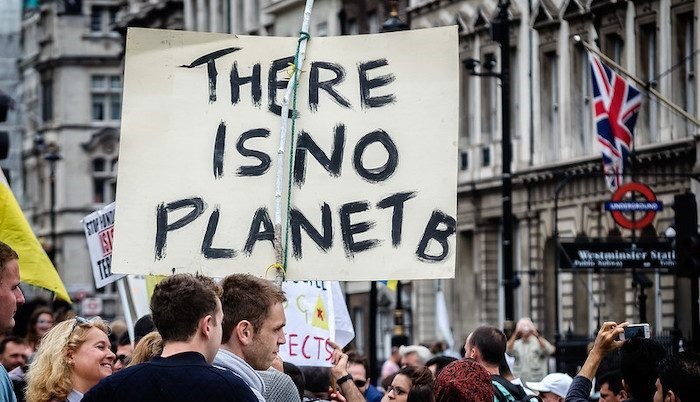
Image by Garry Knight

Image by Garry Knight 

Reflecting on Democracy, Corruption and Climate Change in the COVID-19 Era

In his article “Will Climate Change Destroy Democracy?,” Damon Linker writes: “There’s an oddly apolitical character to most of our talk about environmental threats… Arguably the problem of politics is getting individuals and groups in a given political community to put aside their own self-interest in favor of the common good.”  

Linker’s argument meshes well with Stengers’s understanding of what is actually going on with climate change issues. We are stuck in the theory side of “climate change”–remote, inaccessible, and, therefore, apolitical. The “right to not to pay attention,” as Stengers calls it, is deeply protected by default from these conditions. This right being upheld leads to incremental corruption, further instability, and an inability to trace where it all went wrong (Povitkina). The right to not pay attention to climate change stems from “the guardians'” policy of not paying attention to citizens: it has become a mutual looking away.

The point, however, is to understand what does not work, in order to fix the issue—capitalism, the impossibility of “meddling with” governance by asking questions (55), lack of clarity and trust in leadership…  

Fair, efficient assemblage on the climate crisis has been foreclosed for a long time, but it is Stengers’s hope that with open interactive questions and with reconceptualizations of “the guardians” as human, citizens as participants affected, and of capitalism as an evil spirit preventing unity and stability, collaborative efforts to mitigate panic and to establish a proactive defense against climate change and political risk-offsetting could be achieved.  

Stengers’s underlying message could be read as a call for a true, active democratization of climate crisis discussions. Her chapters here advance the discourse by demonstrating alternative ways to seeing oneself (whether “guardian” or citizen) in the space of climate change discourse and participation.  

References:  

Linker, Damon. “Will Climate Change Destroy Democracy?” The Week.  

https://theweek.com/articles/839648/climate-change-destroy-democracy

Povitkina, Marina. “Reflecting on Democracy, Corruption and Climate Change in the COVID-19 Era,” E-International Relations. 6 May 2020. 

(Yes We Can) Change the Story

A pond collects soil and water residue from oil-sands mining near Fort McMurray, Alberta. The oil sands account for 60 percent of Canada’s oil output.Credit…Ian Willms for The New York Times

This Changes Everything, Naomi Klein’s 2015 documentary based on her book subtitled “Capitalism vs. The Climate,” did not—yet.  But it has had important impact.  Klein’s overarching message hits home especially now given the world-changing pandemic disruption and activism for social justice as we face endemic racism and inequality.  The documentary does feel current as though today’s moment is our “Best chance to build a better world.”

Klein’s message is revolutionary, based on the timeless truth that humans are inveterate storytellers, are compelled to tell stories to make sense of our world.  The problem is that for the last four hundred years, the dominant cultures of the West have been telling a story based on the idea that the Earth is a machine, and humans are its master.  Through the course of the documentary, Klein shows that the economy is a machine, too, capable of being manipulated to feed perpetual growth.

Klein intimately narrates the journey from a Royal Society gathering, where an energized scientist sunnily proposes we have the ability to solve climate change by essentially putting a hose to the sky and spreading tiny particles to block a bit of the sun and therefore the heat.  Switch to a clip of Stephen Colbert interviewing this surely brilliant man, “You’ve buried the lede:  it’s sulphuric acid!”  A touch of levity, but it offers enough of a glimpse of the hubris behind the exercise.  By beginning with the Royal Society, the film places Enlightenment thinkers at its outset.  Locke and property ownership–the use of the land–forefronts the displacement and removal of indigenous peoples in North America.  The film is about the abuse of the land.

Deftly directed by Avi Lewis, the cinematography is breathtaking:  boreal forest in Alberta, prairies stretching to the horizon, and verdant tropical landscapes contrast with the savage rape of the earth and the flight of its native communities.  The scenes of Fort McMurray in Alberta, Canada, are akin to barren moon shots.  ‘No one would ever have a reason to come here if we weren’t extracting the bitumen (thick, tar-like oil)’ one company manager says, without a trace of irony.  The tar sands site produces 60% of Canada’s oil, itself the 4th largest oil producer in the world. 

The documentary explores seven areas around the world, including Canada, the US, Greece, India, and China, where fossil fuel extraction and gold mining is a blight on the land and in communities mostly powerless to fight the exploitation.  The film’s strength is in the human narratives elicited:  a grandmother and granddaughter switching naturally to their native Cree Nation language (think about the forced assimilation schooling and denial of native languages), even if it’s to call a white bureaucrat a Moniyaw for blocking their access to see their ancestral lands.  “The land owns us,’’ says the Cree activist, not the other way around.

“Sacrifice zones” are offered as a source of profit; it’ll grow back to the way it was, they say, thirty years after the extraction, while releasing toxins to the communities downstream.  There’s a gross but real scene of a brash young oil worker—making 150k for 6 months’ work—excusing himself to blow his nose on some cash, gleeful over the scads of money he’s making.

In Beijing, a small boy is asked whether he’s ever seen a star, a blue sky, or a cloud.  No, he answers to each, though allows for ‘a little blue’ in the sky, due to the horrible air pollution. 

“Sustainability is a Marxist concept” masquerading as the redistribution of wealth, shouts one capitalist.

There’s good news:  China has since closed its last coal mine and is heavily invested in producing solar panels.  The Alberta tar sands expansion proposal collapsed in 2019 under pressure from environmentalists and indigenous groups https://www.nytimes.com/2020/02/24/business/energy-environment/frontier-oil-sands-canada.html.

We can take care of the Earth and each other, creating a path to a different future where we can improve quality of life, create meaningful work, greater equality, and an end to ‘sacrifice zones.’  There’s a beautiful transition of Cree Nation singing segueing into Greek, the ethereal nature of the intonations being universal.  It is the less powerful who are compromised by unregulated capitalism and who suffer effects not of their making.  As we protest that Black Lives Matter in our unjust society, we also know the relationship of climate change is one of exploitation.  They are tied together and an epic Best Chance to make a better world is upon us.

https://www.nationalgeographic.com/environment/2019/04/alberta-canadas-tar-sands-is-growing-but-indigenous-people-fight-back/

Will We Enter a New Wave of Energy Development? Shifting Capital via Shifting Paradigms

Andres Malm’s “Long Waves of Fossil Development: Periodizing Energy and Capital” analyzes how the historic phases of capitalism’s evolution required technological leaps in the sources of energy that drive production. Based on Russian economist Nikolai Kondratieff’s theory that capitalism moves in waves consisting of “two phases: an ‘upswing’ characterized by boom conditions, succeeded by a ‘downswing’ of persistent stagnation” (162), we can see how the first long wave of capitalism beginning around 1780 denoted by water-powered industries such as cotton and iron gave way to a second wave propelled by steam, a third run on electricity, the fourth driven by gas and oil, and the fifth long wave we are currently in, typified by computerization of the economy. The transitioning from one long wave to another is not even, incremental growth but rather “proceeds through upsetting contradictions…which impel the expansion and renew the momentum again and again, and it might be these contradictions and the convulsions they generate that do most to produce and reproduce the fossil economy on ever greater scales.” (162).

But it seems that now we have come to an impasse because science is unanimously conveying that humankind has thrown off the balances and processes of the Earth System due directly to continued, elevated levels of C02 emissions from burning fossil fuels. And to reproduce the fossil economy on a larger scale than we are currently maintaining in the name of capitalist gain would have dire consequences to our planet and human civilization. Malm speculates that capitalism could instead propel itself into a sixth long wave by casting off fossil fuels and transition to renewable sources of energy which is exactly what humanity would require to prevent the disastrous scenarios of climate change. Solar, hydro, and wind powered technologies are already established and proven to effectively integrate into our electricity grids but still, our dependency on fossil fuels has not yet been curbed. Malm suggest that a “universal rollout” of these advantageous technologies might “breathe fresh air into languishing capitalism and ensure that we collectively back off from the cliff in time” (181).

Following the theory of long waves of capitalist development and arguing that we have been on the downswing of the fifth wave since the global recession of 2008, Malm implies that we are in fact on the brink of a turning point to a sixth phase. Historically the transitions between phases “are determined by such unforeseeable events as wars and revolutions, the colonization of new countries, or the discovery of new resources—‘those external conditions through whose channel capitalist development flows’” (167).  Our current state of affairs is, quite literally, a crossroads of “upsetting contradictions” inclusive of the consequences of climate change compounded by a global pandemic, severe economic downturn, and political and social instability. Could COVID-19 be the existential threat that pushes us past our paralyzed response to emissions reductions and the climate crisis into the sixth long wave?

Malm asserts that “the eruption of a structural crisis is usually attended by high unemployment, deflation or inflation, deteriorating working conditions, aggressive wage-cuts as capital seeks to dump the costs on labor and widen profit margins—all conducive to intensified class struggle” (171).  And I would argue that we are amid these occurrences right now! But “capital has the power to “lay the foundations for a new epoch of expansion” by creating “a technological revolution, concentrated to one particular sphere” (171).  Historical revolutions, between the first and the fifth long waves of capitalist development have remolded the entire economy, reimagining the technologies of transport and communications systems time and again. “If new life is to be breathed into sagging capitalism, it must come in the most basic, most universal guise: energy” (172). 

Malm contends that renewable energy technologies “perfectly fit the profile of a wave-carrying paradigm” (181). They are of virtually unlimited supply, allow for costs to be reduced, and have vast potential for applications, “causing productivity to spike, spurring other novel technologies — electric vehicle charging systems, smart grids managed online, cities filled with intelligent green buildings — opening up unimagined channels for the accumulation of capital” (181). The groundbreaking innovation of switching completely to renewable sources of clean, emission-free energy would inevitably call for new government policies and financial systems, public education, and an overhaul of our behaviors and habits.  Malm worries that “society, however, is slow in adapting, for unlike technology, social relations are characterized by inertia, resistance, vested interests pulling the brakes, always lagging behind the latest machines” (174). We have seen just that when new, renewable energy technologies emerge. They are initially received by society as a shock and spur push back in the form of skepticism, NIMBYism, etc. which must be overcome in order for them to take hold. In our current situation wherein the COVID-19 pandemic is threatening both global health and economic security, exacerbated by elevated social and political unrest and the ever-looming climate emergency, perhaps a paradigm shift in society at large is inevitably and necessarily what is being set in motion.

A Tutor and its Pupil: An Overhaul of Market Economics

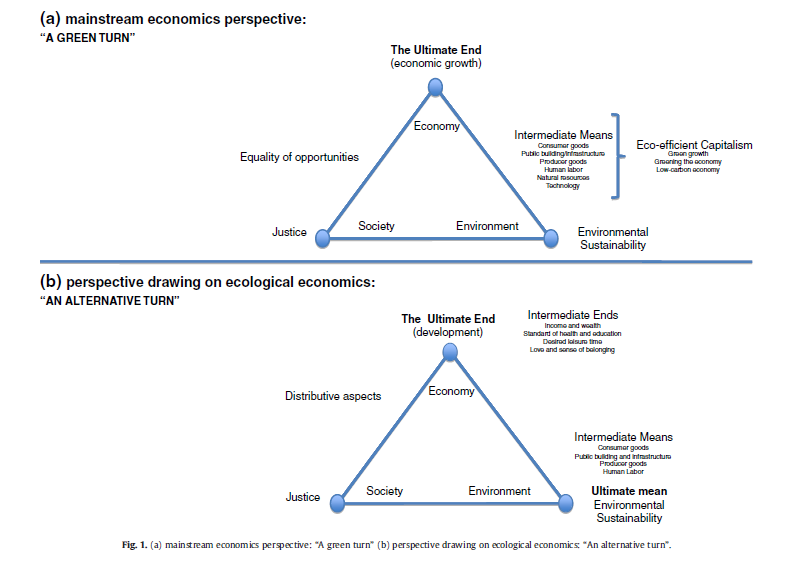
A comparison of two economic models to address Climate Change (from Bina and La Camera’s paper)

In the realm of market economics, though there are several schools of thought, one common denominator remains: the market should be optimized for sufficient gains and growth. As a former economics student, I recognize the importance of governments to balance the desire to sustain economic growth with that of other variables. From Brady Bonds to the market/controlled economy of China to carbon tax initiatives, different economic strategies have been deployed to deal with a host of problematic scenarios from developing countries embroiled in debt to a Communist country wanting to reap the benefits of market economics without succumbing completely to its free enterprise model to the ongoing and existential threat of Climate Change, which, taken to its most logical extreme, represents the most severe threat to our world (not that debt riddled countries and countries desiring to hold onto their customs aren’t important).

Such logic pervades Olivia Bina and Francesco La Camera’s research paper, “Promise and shortcomings of a green turn in recent policy response to the ‘double crisis,’’ which brings into question the efficacy of market economics as an economic system to address the ongoing environmental crisis and a framework to handle contemporary and future economic issues. Bina and La Camera consistently cite “Ecological economics,” drawing on the work of the subfield’s founder, Georgescu-Roegen, whose pioneering work demonstrated the limiting factor of a market economic world is  natural capital, for “Historically, the limiting factor that focused attention was that of manmade capital, but as humanity’s impact on resources and the biosphere move us closer to the so-called Anthropocene (Schellnhuber et al., 2005) and to growing scarcity of natural resources (MEA, 2005; Rockström et al., 2009), the limiting factor shifts to natural capital” (2311).    

The idea that growth is unsustainable and cannot be endless is central to ecological economics and with that, Bina and La Camera offer an alternative model to modern economies privy to both environmental and economic crises (during a ravaging pandemic, a global recession and unrelenting environmental catastrophes, this article feels far too familiar). In their model (see above), aptly labeled “An Alternative Turn,” “Distributive aspects” replaces “equality of opportunities” in the “mainstream economics perspective” of a system of economics centered around bettering both environmental and economic crises, “Eco-efficient Capitalism.” On this model, the researchers explicate that “justice becomes the expected outcome of a redistribution of wealth through the initial equality of opportunities and, at global level, the ‘trickle down’ effect, whilst sustainability is secured as a result of eco-efficient capitalism” (2314). In contrast, Bina and La Camera’s proposed model “requires that the environment be considered an ultimate means (i.e. not substitutable)” for it “envisages the ‘Ultimate End’ linked to a development that embraces the moral and ethical dimensions of the relationship between humanity and the environment” (2314). 

In essence, if there is not a significant recall of the market economics model, the current trajectory of the Climate Change crisis may result in a “Green” economy, but, as Bina and La Camera show, if the overarching goal of the model is to sustain economic growth, treating environmental sustainability as an added benefit of the model, the type of systemic overhaul needed to mitigate the damage of Climate Change won’t come from such a model.    

In the article, Bina and La Camera keep referencing “Robert Skidelsky’s (2009) observation that economics is the ‘tutor of governments,’” underlining the importance of alternative economic models mainly focused on fighting the Climate Change crisis. Skidelsky’s classification of the role of economics in government is on point and though this paper was published in 2011, a wealth of literature has since been published on economic modeling centered on Climate Change. If economics is indeed the tutor of governments, then we should continue to act as facilitators of education for the pupils that are our governments, bridging gaps between disparate fields and disciplines as we work to better the gap between our present and future.

Green New Deal: Economy or Ecology?

The Green New Deal: The top-down initiative that is going to save us from ourselves!

Based off of the New Deal, everyone’s new favorite part of 20th century United States. (Though no one ever talks about the square deal anymore, poor Theodore Roosevelt and his racist statue in front of the Natural History Museum. You naughty rough rider you).

Yes, that is what we need. Because according to history, life was bad, but then it got markedly worse with industrial capitalism in the late 19th century. And it was the New Deal: Government, Keynesian Economics, and investments into social services that steered capitalism onto it’s famously somewhat equitable run post WWII. (Though let’s not mention the Housing Act, a centerpiece to the New Deal and the subsequent redlining of every city in America. Equitable for who?)

And since then we’ve had neoliberalism, which has put us back in the ‘markedly worse,’ section, and we need to shift back to Keynesian economics, to ‘marxism,’ as some would call it, to shore up capitalism yet again and have it more evenly distribute things.

Except now, we have climate change. So no problem, we’ll just invest in renewable energy that will create “jobs,” and we’ll expand the power of our government, even though we also don’t trust our government at all, and have problems with every single leader who rises up to the task.

I guess what I’m saying is, this “Green New Deal,” can’t just be a ‘Greened’, ‘New Deal,’ it truly has to be a paradigm shift in the way we think about growth and the economy in general. As much as everyone loves it, the New Deal created urban sprawl, single family home ownership and segregated redlined cities. The whole socio-ecological mess we are in today is a result of the trajectory of growth that the New Deal put us on.

We need a whole new way of imagining things. The New Deal at the time, was a whole new way of looking at things. Government? Mortgages? Social Security? Until the New Deal, the government in the US was the post office and the armies who chased the Indians off their lands. That was pretty much it. We need a way of looking at things that is not based on Keynesian or classical economics, we need to look at things from a ecological economics perspectives. Cause that is really what this is about, is how to weave our economy in to our larger ecology. It’s not how to weave ecology into our larger economy.

As Bina and La Camera write, “Their framing of problems and solutions remains narrowly confined to the realm of market economies: capital accumulation, innovation, technology and growth remain unquestioned… Ultimately, it is the very notion of goals (ends) that informs the definition of problems and solutions.” (Bina, La Camera, 2314)

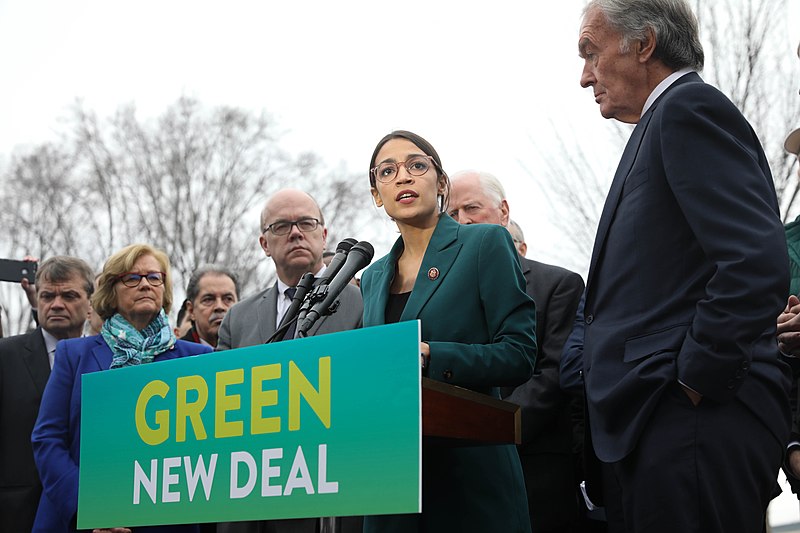
The GND proposal put forward by AOC has potential to be many things. It can be either steered towards the economy or our collective ecology. Neither of which would be bad, in fact either would be markedly better than what we have now. But until we reorient ourselves in terms of what we want our societies to do, give us all an “equal” chance at pursuing happiness, or come together and decide on what happiness would mean for each other, we will still be on the same path towards socio-ecological collapse.

Laudato Si: On Care for Our Common Home

Radical conversion and our throwaway culture: the intersection of Pope Francis and Naomi Klein

In 2015, Pope Francis published a groundbreaking document, “Laudato Si: On Care for Our Common Home,” an encyclical defining the environmental movement as a moral issue for the world’s 1.2 billion Catholics and calling all of humanity to a radical conversion. 

From the pope’s opening words quoting his namesake, St. Francis of Assisi, in praise of “our Sister, Mother Earth, who sustains and governs us,” the pope rejects the anthropocentrism of Judeo-Christian culture in recent centuries. He also acknowledges something that many in this country do not: that unrestrained capitalism and consumerism have led to a grave environmental crisis, and human beings need to change their lives radically to solve this crisis. 

This is not an academic document nor a call for Catholics to recycle, compost, turn down their air conditioners or buy energy-efficient cars, but rather a 246-paragraph statement that our relationship with creation and our relationship with each other are inextricably tied: “We have to realize that a true ecological approach always becomes a social approach; it must integrate questions of justice in debates on the environment, so as to hear both the cry of the earth and the cry of the poor.”

The pope writes in his introduction:

“I will point to the intimate relationship between the poor and the fragility of the planet, the conviction that everything in the world is connected, the critique of new paradigms and forms of power derived from technology, the call to seek other ways of understanding the economy and progress, the value proper to each creature, the human meaning of ecology, the need for forthright and honest debate, the serious responsibility of international and local policy, the throwaway culture and the proposal of a new lifestyle.”

While the pope’s language frequently references Catholic tradition, the encyclical is explicitly addressed to all of humanity. And as such, many of the pope’s words will resonate with environmental acivitsts of all backgrounds: He writes about the “sufferings of the excluded,” the “globalization of indifference,” the earth as a “shared inheritance,” the rejection of the absolute “right to private property,” “sustainable development,” “intergenerational solidarity,” “rampant individualism,” “excessive consumption,” “compulsive consumerism,” and “an integrated approach to combating poverty, restoring dignity to the excluded and at the same time protecting nature.”

For those in the United States fighting for a Green New Deal, these words should sound familiar, albeit from a source surprising to some.  Just as the Green New Deal takes a wide view, addressing climate change side by side with systemic racial, regional, social, environmental, and economic injustices, Pope Francis calls humanity to a more radical conversion that addresses these injustices together. 

The encyclical even led Anglican priest and journalist Giles Fraser to write a piece in The Guardian titled “Pope Francis is a bit like Naomi Klein in a cassock.”

The two certainly have their similarities, at least when they write about the need to reject consumerism. Consider these two passages:

“The strategy of buying and selling “carbon credits” can lead to a new form of speculation which would not help reduce the emission of polluting gases worldwide. This system seems to provide a quick and easy solution under the guise of a certain commitment to the environment, but in no way does it allow for the radical change which present circumstances require. Rather, it may simply become a ploy which permits maintaining the excessive consumption of some countries and sectors.”

“Policy makers are still dancing around the question of whether we are talking about slapping solar panels on the roof of Walmart and calling it green, or whether we are ready to have a more probing conversation about the limits of lifestyles that treat shopping as the main way to form identity, community and culture.”

Can you tell who wrote what? The first is from Laudato Si, the second is from Klein’s On Fire: The Burning Case for the Green New Deal

Pope Francis frequently uses the term “throwaway culture.” In On Fire, Klein makes similar references: “It’s a lot like how this culture treats people. It’s certainly how we’ve been trained to treat our stuff — use it once, or until it breaks, then throw it away and buy some more,” or, more bluntly, “it all gets spent on throwaway crap imported from China destined for the landfill.”

Indeed there is a direct connection between the two: Pope Francis asked Klein to co-chair a Vatican conference on the environment upon the publication of Laudato Si, an encounter Klein writes about in On Fire. And Klein urged world leaders attending the Paris climate change conference to read Laudato Si. Not just summaries, she said. The whole thing.

The burning question now is which path this country will take, if any. Should climate activists in this country go big, and seek the radical change that Pope Francis and Klein advocate, and which the Green New Deal calls for? Or focus narrowly on decreasing carbon output? Pope Francis and Klein certainly make convincing cases for the former. 

Violence

“Climate Change is Violence,” and Disaster Capitalism

A close reading / rhetorical analysis, by Lala St. Fleur

In the title of one particular 2014 article published in the Guardian, columnist Rebecca Solnit urges readers, audiences, and participants in the ongoing discussion about the anthropocene’s environmental crisis to “Call climate change what it is: violence.”

According to Solnit’s article, “extreme, horrific, longterm, widespread” violence “against places and species as well as against human beings” has been perpetrated against Planet Earth and its denizens by the anthropogenic institutions of modern societies, as governments and companies alike “profit off the rapid, violent and intentional destruction of the Earth.” Today’s climate change is the result and fault of mining, fracking, deforestation, urbanization, and the other related problems of modernity. From fossil fuels to world hunger, the land and its people both suffer at the hands of capitalist industrialism. We are violently killing the planet, but Solnit’s article also underlines the fact that in so doing, we are also killing each other.

Solnit points to the 2007-2010 Arab spring bread riot revolts in Africa and the Middle East as a warning of the consequences of climate change, where prolonged droughts caused crop famines that led to the cost of wheat rising, and the people to violently protest in reaction. She draws on parallels to the French Revolution, the bloodiest revolt in European history, which was similarly provoked by the wheat crop failure in 1788. However, while Solnit does acknowledge that the unequal “distribution system is itself a kind of violence,” her article tends to focus a bit too heavily on the social upheaval and “turbulent reactions” that resource scarcity would incite amongst the disenfranchised starving and homeless victims of rising food prices and sea levels, in the event of unchecked global warming and climate change.

People revolt when their lives are unbearable. Sometimes material reality creates that unbearableness: droughts, plagues, storms, floods. But food and medical care, health and well-being, access to housing and education – these things are also governed by economic means and government policy…. In every arena, we need to look at industrial-scale and systemic violence, not just the hands-on violence of the less powerful.

Solnit, 2014.

In her article, Solnit states, “I suspect people will be revolting in the coming future against what they revolted against in the past: the injustices of the system. They should revolt, and we should be glad they do, if not so glad that they need to.” In reading Solnit’s article, I found myself wishing that she would further tackle the need to people to redirect their aggravation and violence at the institutions truly at fault for systemic inequality. But for all that Solnit made a point of overemphasizing that “climate change is violence,” she focused that violence on the bottom-up responses to food and land shortages, rather than the top-down causes behind and process by which that violence was committed in the first place.

Climate change is global-scale violence…. Once we call it by name, we can start having a real conversation about our priorities and values. Because the revolt against brutality begins with a revolt against the language that hides that brutality.

Solnit, 2014.

Solnit says that we must revolt against the language that hides the brutality of climate change violence–but that is the brutality of hunger, poverty, disenfranchisement, and exploitation. Climate change is violence, sure. But I think Solnit should have just come right out and said plainly that Capitalism is Violence. Capitalism is the vehicle by which industrialization and economic inequality continue to propel themselves across the world, effectively hiding its heinous crimes against humanity behind the language of economics, profit, and neoliberal free market regulation that all allow fossil fuel companies to pump the planet full of toxic emissions with near impunity in the first place.

Over the course of this Summer 2020 semester, I have become increasingly reminded of a class on disaster capitalism I took in my Spring 2020 archaeology course. We read and responded to several pieces by Naomi Klein, David Harvey, and more, on the topic of the unequal effects of climate change and natural disasters on different socioeconomic and racial groups. I made a PowerPoint for my class presentation, which I have uploaded below in an truncated form more pertinent to this semester’s course, in regards to what climate change violence looks like:

David Harvey’s 2017 article “There’s Nothing ‘Natural’ about a Natural Disaster,” and Neil Smith’s 2006 article “There’s No Such Thing as a Natural Disaster” both underline the ways that systemic inequality and capitalism are the real acts of violence against humanity and the earth. Mother Nature has her cycles, and she’s going to do what she always does–there have been recurring greenhouse effects and ice ages since the continents formed billions of years ago. But it’s the ways people react to those changes (climate change, Katrina, Sandy, Tohoku, volcanoes, droughts, and other disasters) that reveal the real acts of violence perpetrated by and against people and the planet itself, as well as highlighting precisely who the most numerous victims of “climate change violence” truly are.

Naomi Klein’s 2014 book, This Changes Everything Capitalism vs. the Climate, highlights the need “to address the twin crises of inequality and climate change at the same time,” (Klein, 2014: 372). Multiple crises are at work, by which climate change is only one aspect of an even larger problem based on unchecked over development and capitalist exploitation of everything the earth produces, from resources to geological disasters themselves. And so, a revolt against climate change, though indeed intrinsically linked to socioeconomic inequality, cannot by itself knock the capitalist system on its ear, particularly since several aspects tied to climate change can be tackled separately and with greater efficiency as general environmental concerns or cases of socio-economic/racial inequality (the pipelines as an issue of Native American land rights; Flint, Michigan’s water crisis as an example of gross governmental negligence). As such, I am unconvinced that Solnit’s “climate change is violence” is the right declarative statement that will rally the masses.

However, I do agree that the consequences unchecked climate change will exacerbate (namely: resource shortages) will more than likely be the lynch-pin that inevitably triggers both violent and non-violent revolts against exploitative capitalist, industrialist, and imperialist systems. But the masses will need to take aim at the right target first, otherwise these circular arguments will just keep spinning, as finite Global Green New Deals only scratch the surface of the true violence against society.